The development of audiology and hearing aid technology has given children with congenital hearing loss the opportunity to return to the sound world, to learn language by listening, and eventually to integrate into the mainstream society of spoken language communication. Audiologists assess and adjust hearing aids through audiometry, so that hearing AIDS can play the greatest and children with hearing loss can get the best listening effect. After fitting and implanting cochlear implants and turning them on, children need to wear hearing AIDS consistently. Coch implant and hearing aid are precision electronic devices, which need to be used correctly and well maintained to maintain their normal working status. Therefore, medical intervention is far from enough, and there needs to be a follow-up and continuous management of hearing ability to ensure the smooth progress of aural language rehabilitation.
Since the teaching reform organized by the China National Center for Hearing and Speech Rehabilitation (hereinafter referred to as “CNCHSR”) 2008, teachers in hearing and speech rehabilitation institutions have to undergo strict and professional training before taking up their posts, and continue to train as equipment is constantly updated As a result, the ability of professionals in hearing and speech rehabilitation institutions to correctly use and wear hearing AIDS has significantly improved. The rehabilitation of deaf children aims to enable them to better into ordinary kindergartens and schools, and ultimately into mainstream society. Thanks to the breakthrough progress made in hearing and speech rehabilitation, deaf children have a high rate of integration into schools. However, at present, ordinary school teachers are different from rehabilitation teachers in institutions, and their ability to manage hearing has great room for improvement. This requires deaf children to good self-management skills for hearing AIDS to smoothly transition through the integration process. This paper has an in-depth exchange with parents on how to guide deaf children to learn to wear AIDS by themselves.
Parents should know how to wear hearing aids correctly
Before guiding your child to wear hearing aids by themselves, parents should first learn to wear hearing aids and standardly. It is recommended that parents do the following 2 points well:
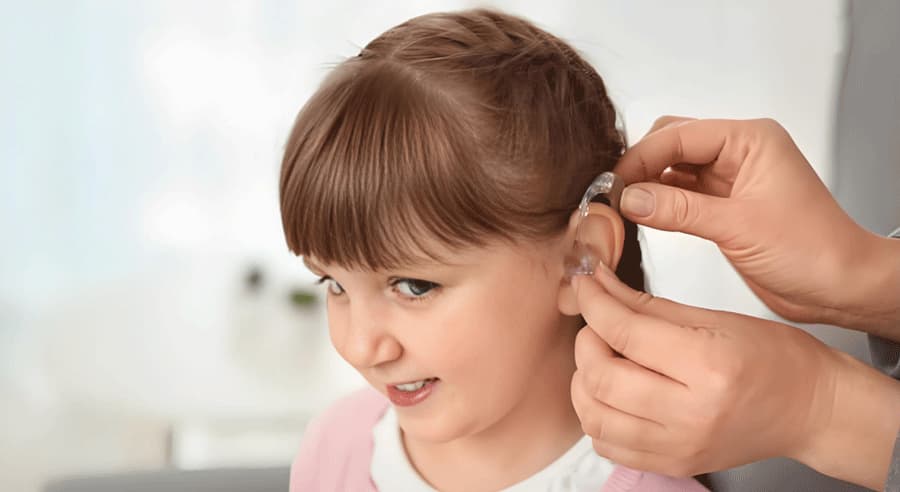
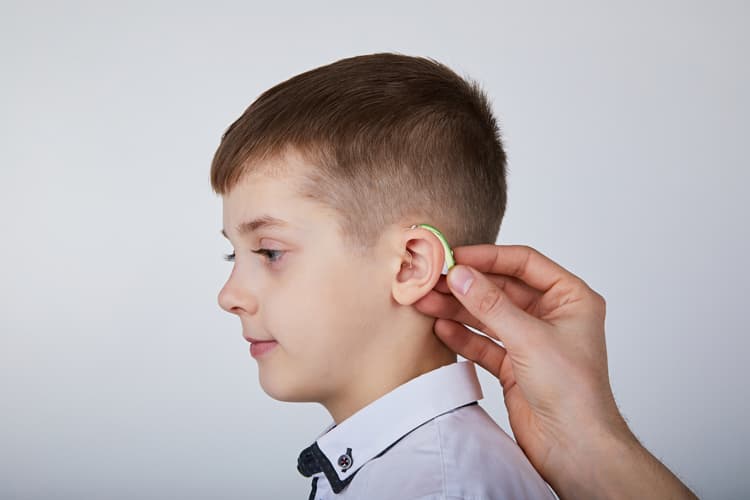
● Insist on wearing hearing aids for your child; ● Use the correct wearing to wear hearing aids for your child, see Figure 1 for the correct wearing of hearing aids.
Figure 1: Proper wearing of hearing aids
Children should wear hearing aids for as long as possible every day, following the principle that if the eyes are open the ears should be open as well, to allow them to listen better. In clinical practice, many parents cannot consistently ensure their children wear hearing aids, and this issue is even more among parents who are just getting their children accustomed to wearing them. Some parents may not be able to accept that their child has a hearing loss or needs to wear hearing aids; some may not know how to wear the hearing aids or, despite trying, may cause redness and swelling in their child’s ear canal or scalp due to improper placement, leading the to refuse to wear the hearing aids due to discomfort; and there are also issues related to the child’s emotional acceptance of new things, such as defiance, rebellion, challenging authority, jealousy, and worry, which can lead to an inability to consistently wear hearing aids.
The process of parental guidance begins with observation to identify problems, followed by assessment help parents understand the reasons, and finally, individualized guidance is provided based on the specific reasons. During the morning check-in at the kindergarten, group teachers will check the childrens hearing aid wearing by touching, looking, asking, and inspecting. If any issues with the hearing aid wearing are discovered, the teacher will provide guidance to the parents on the and follow up on the effectiveness of the guidance in the next few days. If the child’s wearing problems still persist after several guidance sessions, the group teacher will refer the to the individualized teacher, who will assess the parents and provide individualized guidance and intervention strategies based on the diagnosis. For younger children wearing hearing aids, a common issue parents face not being able to put on the hearing aids. When parents are unable to do so, they should first remain calm and understand that operating hearing aids is not complicated. They can learn the teacher seriously during individualized classes, dare to try, and practice more. The teacher will also guide and teach the parents step by step to gradually lead the child from partial participation full participation in the wearing and removal of the device based on the child’s abilities.
Children wearing hearing aids often experience whistling due to improper wearing, which is notducive to listening to sounds. If the child still experiences whistling after wearing the hearing aid, it is often because the parent has not worn the earmold properly. The needs to wear the earmold properly in sequence from earmold lubrication maintenance, the angle of connection between the earmold and the hearing aid, the installation angle of sound guide tube and the earmold, and the parts of the earmold in the ear canal, concha, and scutum. The audiologist at thehong Yi Kang hearing clinic will provide relevant guidance to parents, and subsequent individualized teaching will also provide targeted guidance to parents based on each child’s specific situation
One of the most common problems in cochlear implant wearing is that the cochlear implant is not worn in the correct position. From the of listening, the audiologist recommends wearing the cochlear implant processor near the ear, as shown in Figure 2. However, in teaching, it was found that, for children who have just entered the kindergarten, their cochlear implants were not worn near the ear. Some parents would clip the speech processor to the top of the head, some would place it near the collar or even behind the back, especially when it is cold and they are wearing a thick coat outside, the speech processor is placed inside the coat, affecting listening effect. Usually, there are two reasons that prevent parents from wearing the cochlear implant near the auricle: one is that parents feel that children are too young and auricle is relatively soft, unable to bear the weight of the speech processor, which will make the ears become less attractive over time; the other reason is the moisture-proof, some children sweat a lot, especially in summer, there will be a lot of sweat near the ears, and the cochlear implant will be damaged if it is soaked in for a long time. Therefore, the author recommends using a hairband to fix the speech processor to relieve. The hairband can not only share the weight of the cochlear but also absorb sweat to avoid the processor from getting damp, and the correct wearing of the hairband is shown in Figure 3.
Figure 2 Correct wearing of the cochlear implantFigure 3: Proper wearing of the hairband.
Cultivating good wearing habits in young children
Good habits are the ladder to acquiring skills. is very important to help deaf children develop good habits of wearing hearing AIDS, first guiding children to develop good wearing habits, and then cultivating their wearing ability. Good wearing habits hearing AIDS include:
● Hearing AIDS should not be taken off at will; ● After taking off the hearing AIDS, put them in a fixed position.
is required that young children should not take off their hearing AIDS without the permission of their parents. If the child particularly rejects hearing AIDS and often takes them off without the permission of the, parents need to ask the audiologist or the special education teacher for help, and evaluate from the comfort of wearing, emotions and other aspects, and then clearly intervene for the.
For children aged 2 to 3, sometimes it is impossible to cultivate the habit of not taking off hearing AIDS at will through family education, and parents can try let the child go to day care. In small class collective teaching, the class teacher will create a good atmosphere of continuous wearing of hearing AIDS in the class according to the goals and put forward by the audiologist, and let the children insist on wearing hearing AIDS every day, and guide the children to develop the habit of wearing hearing AIDS positively, so that peers can set an example for each other and influence each other. We have seen many children who refuse to wear hearing AIDS at home, but after entering the collective teaching environment, develop the habit of not taking off hearing AIDS in a subtle way.
In the process of using hearing AIDS, the situation of falling is sometimes inevitable. The cochlear mainly falls down from the headpiece, and the hearing aid often flips from the back of the auricle to the front of the auricle. In these cases, should consciously take specific actions to reposition the child’s hearing AIDS, and at the same time, tell the child in words that the hearing AIDS should be immediately returned to their position after falling down.
On the basis of getting used to wearing devices, it is necessary to put forward normative requirements for young children, guide young children to manage their hearing AIDS, and let young children know that they need to put their hearing AIDS into a dry box after taking them off, and the dry box should be placed in a fixed position In collective teaching, teachers will use the form of area corner to place hearing AIDS in a fixed area in the class, and at the same time, they will also design the rules the area corner according to the age of the children in the teaching process. For children in small classes, the teacher will put forward the rules of managing hearing AIDS before the child goes bed at noon. Let children know what they should do before going to bed at noon and where they should put their equipment. For children in the middle or large class, they have hands-on ability, higher language and cognitive level, and will ask the children to take off the equipment and put it into the box prepared by the teacher by themselves. The author that parents also put hearing AIDS or charging accessories in a relatively fixed position at home, and ask the children to go to a fixed position to take off the equipment before going to bed night and when they get up in the morning. Consolidate the practice of the child in the kindergarten at noon, and promote the cultivation of good habits of the child through synchronization of home and school.
Teachers and parents can further strengthen the habit of children wearing hearing AIDS through affirmation and reward. Good parent-child relationship and teacher- relationship are the basis for cultivating good habits, and can also enhance children’s self-confidence
Focus on the cultivation of children’s ability to wear hearing aids
For deaf children, having the to wear hearing aids independently is particularly important for their entry into ordinary kindergartens and schools. In the teaching of guiding deaf children to learn to wear and take off hearing aids it is suggested to use assessment-guided teaching and learning, which mainly includes:
● Distinguishing between left and right ears ● Wearing and taking off hearing aids
Hearing aids are divided into left and right, and parents must clearly mark the left and right ears on the hearing aids. In addition to parents being able to distinguish between left and right ears skillfully, it is also necessary to ensure that teachers can also distinguish between left and right ears. For children whose understanding ability reaches a certain level, parents should teach how to distinguish between left and right ears of hearing aids.
It is recommended that parents assess the child’s fine motor, language, cognitive understanding, and communication skills before children to wear and take off hearing aids independently, and then guide and develop the child’s higher abilities according to the theory of the zone of proximal development, laying a solid for them to wear hearing aids independently.
The author cooperates with the two disciplines of rehabilitation and education to help children master the skills of self-wearing and taking off aids smoothly. First, an assessment is conducted in collective teaching, evaluating the child’s level of wearing and taking off hearing aids into three categories: completely unable, able to wear take off partially by themselves, or basically able to wear and take off by themselves. The collective teacher feedbacks to the individual teacher, and in individual rehabilitation teaching, the principle starting with assessment and ending with evaluation is followed, evaluating both the child and the parents. During the process of parents participating in individual teaching, through four steps: informing, demonstrating,, and feedback, parents are guided and taught to guide their children step by step to wear and take off hearing aids by themselves. Individual teachers will also use a regular class entry system evaluate and confirm the level of children’s self-wearing and taking off hearing aids in collective classes. The effective combination of rehabilitation and teaching, continuous communication and feedback, enables to learn to wear hearing aids independently.
Conclusion
In the process of guiding children to wear hearing aids independently, the three disciplines of medicine, rehabilitation and education work together to promote and improve the rehabilitation effects of children and promote integration. The medical specialty proposes goals and needs, the teaching specialty guides deaf children to develop good habits, step by step to acquire the skills of self-hearing management, and the rehabilitation teaching is through personalized diagnosis and precise and effective one-to-one intervention, to the children parents separately for rehabilitation guidance. Here, it is hoped that parents will also pay attention to this and learn to use the correct methods and strategies to guide children to learn to wear hearing independently under the professional guidance of rehabilitation teaching, so that children can better achieve integration. Conclusion
The hearing aid dome is the “bridge” connecting the hearing aid to the user’s ear canal, and its functions cover three dimensions: acoustic optimization, physical fixation, and health protection. When choosing, it is necessary to consider the type of hearing loss, the anatomy of the ear canal, lifestyle, and the model of the hearing aid comprehensively, and to adjust under the guidance of a professional audiologist to maximize the hearing effect. The role of the hearing aid dome is not only about comfort but also directly affects the transmission effect of sound and the overall performance of the hearing aid. Below is a detailed guide to choosing a hearing aid dome, covering types, applicable scenarios, precautions, and maintenance suggestions to help you make the right choice based on your personal needs: 01 hearing aid dome types and characteristics 1 Standard hearing aid dome (universal type) 2 Custom ear mold 3 Open hearing aid dome (with ventilation hole) 4 Closed hearing aid dome 5 RIC/RITE dedicated hearing aid dome 02 Key Factors to Consider When Choosing Ear Plugs 1 Degree of Hearing Loss 2 Comfort and Fit 3 Management of Plugged Ear Effect 4 Usage Scenarios 5 Special Needs 03 Notes for Trial and Adjustment 1 Professional Fitting: 2 Feedback Squealing Troubleshooting: 3 Comfort Test: 04 Maintenance and Replacement of Ear Plugs 1 Cleaning Methods: 2 Replacement Cycle: 3 Storage Recommendations:
Nowadays, Bluetooth technology has been widely used in various fields, and the hearing aid industry is no exception. For example, the Bluetooth technology we often use been well applied to hearing aid products, bringing more convenience and practicality to the user experience. Many functions that could not be realized in the past have now been realized through technology. The Bluetooth function of the hearing aid is the biggest change in the function of the hearing aid in recent years. The advantages of Bluetooth hearing aids Bluetooth hearing aids integrate Bluetooth functionality, allowing wireless connection to your mobile phone or television. This is a very convenient feature for hearing aids. With Bluetooth hearing aids, mobile phone or television signals are transmitted directly to the hearing aid via radio (Bluetooth), and the effect is very good, with no distortion and no loss of signal. Bluetooth-enabled hearing aids can be wirelessly programmed, connected to mobile phones to make calls and listen to music, connected to wireless microphones to achieve long-distance communication and communication, wirelessly connected to televisions, etc., watching TV will not affect others, making listening clearer. Moreover, Bluetooth hearing aids can also be wirelessly connected to debugging software, making it more convenient to debug hearing aids. Real-time APP connection Bluetooth functionality is not just about connecting hearing aids to your phone, it also works in conjunction with a Bluetooth hearing aid app, which allows you to control your hearing aids from your phone at any time and anywhere. However, some Bluetooth hearing aid models or brands have their own app applications, which can fully leverage the advantages of Bluetooth functionality. Solving the problem of making phone calls The problem of unclear and inconvenient phone calls has been solved. The hearing aid only needs to be paired and connected with the mobile phone’s Bluetooth. When there is an incoming call, the Bluetooth hearing aid becomes a wireless Bluetooth headset, avoiding the feedback phenomenon of the hearing aid. Solving the problem of watching TV The Bluetooth headset can effectively reduce the attenuation of sound. Some deaf users like to watch TV, but ordinary hearing aids are still not very effective. Now that there is a Bluetooth hearing aid, you can pair it with a TV box for watching TV. After matching, the sound in the TV is directly transmitted to the hearing aid, which improves the listening effect and does not affect the family watching TV. Realizing long-distance transmission Bluetooth hearing aids can achieve long-distance transmission, with no attenuation of sound transmission, good transmission stability, clearer and more comfortable sound, less signal interference, and can be connected with wireless accessories for use. It can be connected with a wireless microphone, and the microphone can directly receive the language signal, which can achieve long-distance conversation, such as conversation places such as meetings and classrooms. Connect your phone to listen to music and scroll through videos Bluetooth hearing aids can connect to your phone via wireless Bluetooth function, which can better answer calls, watch videos, listen to music, etc. For deaf people who love music and like to listen to songs and scroll through short videos, this function is extremely friendly to them, and there is no need to worry about it. Reduce interference from the surrounding environment Wireless Bluetooth technology can effectively reduce interference from the surrounding environment. We can connect the hearing aid to Bluetooth and choose to attenuate the microphone function, so we only hear the signal sound from Bluetooth, and block other interference sources. With the increasing demand for telephone communication, video chat, watching TV, browsing short videos and other behaviors deeply into everyone’s life, our demand for hearing AIDS will also change. Therefore, when the existing hearing AIDS can not meet the above behaviors, you can consider using a wireless hearing AIDS, through the wireless connection between hearing AIDS and devices, so that listening effects are better. However, no matter how convenient the wireless Bluetooth function of the hearing aid is, it is not perfect and still has shortcomings, such as high price, fast power consumption, model restrictions, unstable signals and so on. In fact, wireless Bluetooth hearing AIDS are not the needs of all hearing aid users, users can choose according to their own actual situation, believe that in the future, the wireless Bluetooth technology of hearing AIDS will be better and better.
Why do hearing aids vary so much in price? If you’re considering purchasing a hearing aid, you might be surprised to find that the price range in the market can be extremely wide—from cheap devices costing a few tens of dollars to high-end models that can go up to a few thousands. Why is there such a big price gap? Is an expensive hearing aid really better than a cheaper one? This article will provide you with a detailed analysis of the factors behind the price of hearing aids, helping you make a more informed decision when it comes to making a purchase. First and foremost, the price difference of hearing aids is closely related to their types. Currently, hearing aids on the market are mainly divided into the following categories: (1) Over-the-Counter (OTC) Hearing Aids (2) Standard Digital Hearing Aids (3) High-end Custom Hearing Aids (4) Implanted hearing aids (such as cochlear implants) (1) Material The materials used in cheap and expensive hearing aids are different. Hearing aids made from low-cost materials have a shorter lifespan and the sound amplification and reproduction will have a significant distortion, affecting listening quality and satisfaction. Expensive hearing aids use better materials, which last longer and are less likely to break. The sound reproduction is more realistic and clear. (2) Technology Cheap hearing aids are more like a combination of speakers, amplifiers, and microphones. They simply amplify the sound without any processing, including amplifying the surrounding noise along with the sound into the ear canal. Expensive hearing aids have chips and algorithms. They process the collected sound, amplifying the speech sounds more and suppressing the noise. This makes the sound heard by the ear clearer and cleaner. (3) Function Cheap hearing aids can only simply amplify the sound, without noise reduction function, without strong sound interruption function, and are not friendly to the ears. Expensive hearing aids have an automatic noise reduction function, have an instantaneous loud sound interruption function, avoid too loud sound breaking the eardrum, and some expensive hearing aids have a Bluetooth direct connection function, which allows us to hear music and watch videos with a cleaner sound. (4) Service (5) Brand and market positioning (6) Appearance and customization (1) Advantages and Disadvantages of Cheap Hearing Aids (<$500) ✅Pros: ❌Cons: (2) Advantages and Disadvantages of Mid-Range to High-End Hearing Aids ($500-$5,000) ✅Pros: ❌Cons: 4.How to Choose the Right Hearing Aid for You? (1) Assess Your Hearing Needs (2) Set a Budget (3) Trial Period and After-Sales Service (4) Consult with a Hearing Expert As technology advances and market competition intensifies, the price of hearing aids may gradually decrease, especially with the growing popularity of OTC hearing aids that make it possible for more people to get help at a lower cost. However, high-end hearing aids will still maintain higher prices due to ongoing technological innovations. Conclusion: The most expensive is not always the best, but the cheapest may not be sufficient. The price difference in hearing aids reflects a combination of technology, service, and brand value. If you have mild hearing loss, OTC hearing aids can be a good choice; but if you need better sound quality and adaptability, investing in a mid to high-end hearing aid might be more worthwhile. Most importantly, make an informed choice based on your hearing needs, budget, and lifestyle, and consult a professional audiologist if necessary. We hope this article helps you understand the price differences in hearing aids and find the best solution for you! If you have any questions, feel free to leave a comment and join the discussion. Your hearing health is worth the investment, choose the right hearing aid and let the world sound clearer! 🎧