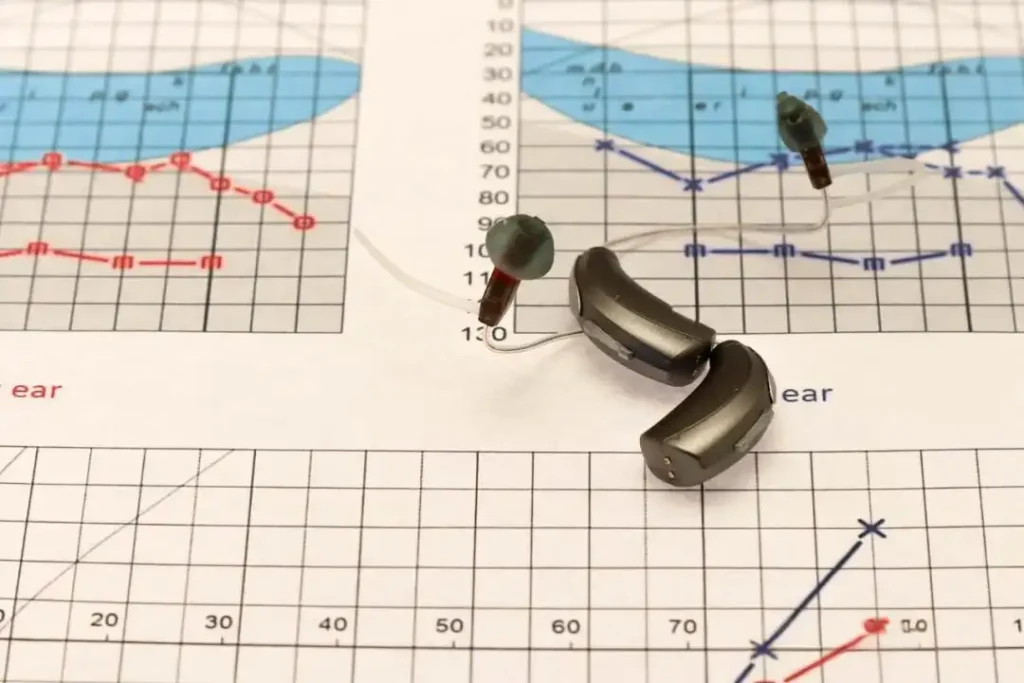
Pure tone audiometry is a core method to determine the smallest hearing (dB HL) perceived by the human ear at various frequencies through air conduction headphones and bone conduction vibrators. It is used to assess the degree and nature of hearing loss (con, sensory neural, or mixed).
Basic physiology of hearing:
– Air conduction (AC): Sound is conducted through the external auditory canal →mpanic membrane → auditory ossicles → inner ear → auditory nerve;
– Bone conduction (BC): Sound directly stimulates the inner ear through the vibration the skull, bypassing the external and middle ear.
Clinical significance:
1. Localize the lesion site: The difference in thresholds between air bone conduction can distinguish between conductive deafness, sensory neural deafness, and mixed deafness;
2. Quantify hearing loss: According to the World Health (WHO-1997) classification standard for hearing impairment, hearing loss is divided into mild (26-40 dB HL), moderate (41-0 dB HL), severe (61-80 dB HL), and profound (>81 dB HL);
3. Guide the adjustment of hearing: The audiogram can directly map the gain requirements of hearing aids, such as those with a steep high-frequency decline requiring targeted compensation
2.Pure tone audiometry detailed explanation of the entire process
Pre-test Preparation
Environmental Requirements:
– Soundproof room background noise should be ≤30 dB(A-weighted), and the ambient noise should be regularly checked with a sound level meter;
– Equipment Calibration: Hearing aids should be calibrated at least once a year to ensure that the frequency (±3%) and intensity (±2 dB) errors are within the standard range.
Patient Communication and Evaluation:
– Screening for contraindications: Patients with ear pain, sudden hearing loss in recent days, dizziness, otogenic discharge, etc., need to be referred to an otologist;
– Collection of medical history: Including the duration of hearing loss, history of otological surgery, history of hearing aid use, etc., which should be recorded in the file.
Air Conduction Test (AC)
Operation Steps:
1. Wear headphones: Left ear with blue mark, right ear with red mark, to avoid confusion between left and right;
2. Frequency test sequence:
– Starting frequency: 1000 Hz (the frequency to which the human ear is most sensitive);
– The method of reducing 10 and increasing 5: Reduce the sound pressure level by 10 dB when the patient hears the sound, and increase it by 5 dB when the patient does not hear it, repeat until the same intensity is heard twice;
– Masking method: When the difference between the hearing of both ears ≥40 dB, masking noise (such as narrowband noise) needs to be applied to the better ear to avoid the interference of “shadow hearing”.
Bone Conduction Test (BC)
Operation Points:
– Place the bone conduction vibrator at the mastoid process, avoiding contact with the auricle, and avoid pressing the hair;
– Test frequency range: 250 Hz ~ 4000 Hz (more sensitive to low frequency);
– The principle of masking is the same as that of air conduction, but it should be noted that the bone conduction vibrator may cause vibratory tactile interference.
3. Common Technical Difficulties and Solutions
1.Testing for Children and Special Populations
Game Audiometry: Suitable for children aged 3 to 5, improving compliance through games such as “Listen and Place the Blocks”;
Elderly Patients: Shorten the duration of each test (10 minutes) to avoid hearing fatigue affecting accuracy.
2.Handling Abnormal Results
Inter-Frequency Threshold Difference > 20 dB Perform additional half-octave frequency tests (e.g., 750 Hz, 1500 Hz, etc.);
Medical history inquiry a clear history of noise exposure, suspected noise-induced hearing loss, test 3000 Hz, 6000 Hz;
Abnormal Bone Con Threshold: Check the position of the oscillator, rule out middle ear lesions (such as otosclerosis).
3.Key Points for Interpretation of Audi
4.Practical Case Demonstration
Case 1: High-Frequency Sudden Decline Hearing Loss
Test Results: Air conduction above 2000 Hz > 60 dB HL, bone conduction thresholds normal;
Hearing Aid Adjustment Suggestions: Enhance high-frequency compensation combined with frequency shifting function.
Case 2: Conductive Deafness (Otitis Media)
Test Results: Air conduction thresholds generally > 4 dB HL, bone conduction thresholds normal;
Treatment Plan: Treat otitis media preferentially, reassess after recovery.
5.Extension: Combination of Pure Tone Audiometry and Hearing Aid Fitting
Gain Calculation: Set the initial gain value of the aid based on the threshold values of each frequency according to the “1/2 Gain Rule”;
Effect Verification: Evaluate the compensation effect through pure tone audometry after wearing the hearing aid (sound field test), and the target hearing threshold should be close to 25 dB HL.
The hearing aid dome is the “bridge” connecting the hearing aid to the user’s ear canal, and its functions cover three dimensions: acoustic optimization, physical fixation, and health protection. When choosing, it is necessary to consider the type of hearing loss, the anatomy of the ear canal, lifestyle, and the model of the hearing aid comprehensively, and to adjust under the guidance of a professional audiologist to maximize the hearing effect. The role of the hearing aid dome is not only about comfort but also directly affects the transmission effect of sound and the overall performance of the hearing aid. Below is a detailed guide to choosing a hearing aid dome, covering types, applicable scenarios, precautions, and maintenance suggestions to help you make the right choice based on your personal needs: 01 hearing aid dome types and characteristics 1 Standard hearing aid dome (universal type) 2 Custom ear mold 3 Open hearing aid dome (with ventilation hole) 4 Closed hearing aid dome 5 RIC/RITE dedicated hearing aid dome 02 Key Factors to Consider When Choosing Ear Plugs 1 Degree of Hearing Loss 2 Comfort and Fit 3 Management of Plugged Ear Effect 4 Usage Scenarios 5 Special Needs 03 Notes for Trial and Adjustment 1 Professional Fitting: 2 Feedback Squealing Troubleshooting: 3 Comfort Test: 04 Maintenance and Replacement of Ear Plugs 1 Cleaning Methods: 2 Replacement Cycle: 3 Storage Recommendations:
Nowadays, Bluetooth technology has been widely used in various fields, and the hearing aid industry is no exception. For example, the Bluetooth technology we often use been well applied to hearing aid products, bringing more convenience and practicality to the user experience. Many functions that could not be realized in the past have now been realized through technology. The Bluetooth function of the hearing aid is the biggest change in the function of the hearing aid in recent years. The advantages of Bluetooth hearing aids Bluetooth hearing aids integrate Bluetooth functionality, allowing wireless connection to your mobile phone or television. This is a very convenient feature for hearing aids. With Bluetooth hearing aids, mobile phone or television signals are transmitted directly to the hearing aid via radio (Bluetooth), and the effect is very good, with no distortion and no loss of signal. Bluetooth-enabled hearing aids can be wirelessly programmed, connected to mobile phones to make calls and listen to music, connected to wireless microphones to achieve long-distance communication and communication, wirelessly connected to televisions, etc., watching TV will not affect others, making listening clearer. Moreover, Bluetooth hearing aids can also be wirelessly connected to debugging software, making it more convenient to debug hearing aids. Real-time APP connection Bluetooth functionality is not just about connecting hearing aids to your phone, it also works in conjunction with a Bluetooth hearing aid app, which allows you to control your hearing aids from your phone at any time and anywhere. However, some Bluetooth hearing aid models or brands have their own app applications, which can fully leverage the advantages of Bluetooth functionality. Solving the problem of making phone calls The problem of unclear and inconvenient phone calls has been solved. The hearing aid only needs to be paired and connected with the mobile phone’s Bluetooth. When there is an incoming call, the Bluetooth hearing aid becomes a wireless Bluetooth headset, avoiding the feedback phenomenon of the hearing aid. Solving the problem of watching TV The Bluetooth headset can effectively reduce the attenuation of sound. Some deaf users like to watch TV, but ordinary hearing aids are still not very effective. Now that there is a Bluetooth hearing aid, you can pair it with a TV box for watching TV. After matching, the sound in the TV is directly transmitted to the hearing aid, which improves the listening effect and does not affect the family watching TV. Realizing long-distance transmission Bluetooth hearing aids can achieve long-distance transmission, with no attenuation of sound transmission, good transmission stability, clearer and more comfortable sound, less signal interference, and can be connected with wireless accessories for use. It can be connected with a wireless microphone, and the microphone can directly receive the language signal, which can achieve long-distance conversation, such as conversation places such as meetings and classrooms. Connect your phone to listen to music and scroll through videos Bluetooth hearing aids can connect to your phone via wireless Bluetooth function, which can better answer calls, watch videos, listen to music, etc. For deaf people who love music and like to listen to songs and scroll through short videos, this function is extremely friendly to them, and there is no need to worry about it. Reduce interference from the surrounding environment Wireless Bluetooth technology can effectively reduce interference from the surrounding environment. We can connect the hearing aid to Bluetooth and choose to attenuate the microphone function, so we only hear the signal sound from Bluetooth, and block other interference sources. With the increasing demand for telephone communication, video chat, watching TV, browsing short videos and other behaviors deeply into everyone’s life, our demand for hearing AIDS will also change. Therefore, when the existing hearing AIDS can not meet the above behaviors, you can consider using a wireless hearing AIDS, through the wireless connection between hearing AIDS and devices, so that listening effects are better. However, no matter how convenient the wireless Bluetooth function of the hearing aid is, it is not perfect and still has shortcomings, such as high price, fast power consumption, model restrictions, unstable signals and so on. In fact, wireless Bluetooth hearing AIDS are not the needs of all hearing aid users, users can choose according to their own actual situation, believe that in the future, the wireless Bluetooth technology of hearing AIDS will be better and better.
Why do hearing aids vary so much in price? If you’re considering purchasing a hearing aid, you might be surprised to find that the price range in the market can be extremely wide—from cheap devices costing a few tens of dollars to high-end models that can go up to a few thousands. Why is there such a big price gap? Is an expensive hearing aid really better than a cheaper one? This article will provide you with a detailed analysis of the factors behind the price of hearing aids, helping you make a more informed decision when it comes to making a purchase. First and foremost, the price difference of hearing aids is closely related to their types. Currently, hearing aids on the market are mainly divided into the following categories: (1) Over-the-Counter (OTC) Hearing Aids (2) Standard Digital Hearing Aids (3) High-end Custom Hearing Aids (4) Implanted hearing aids (such as cochlear implants) (1) Material The materials used in cheap and expensive hearing aids are different. Hearing aids made from low-cost materials have a shorter lifespan and the sound amplification and reproduction will have a significant distortion, affecting listening quality and satisfaction. Expensive hearing aids use better materials, which last longer and are less likely to break. The sound reproduction is more realistic and clear. (2) Technology Cheap hearing aids are more like a combination of speakers, amplifiers, and microphones. They simply amplify the sound without any processing, including amplifying the surrounding noise along with the sound into the ear canal. Expensive hearing aids have chips and algorithms. They process the collected sound, amplifying the speech sounds more and suppressing the noise. This makes the sound heard by the ear clearer and cleaner. (3) Function Cheap hearing aids can only simply amplify the sound, without noise reduction function, without strong sound interruption function, and are not friendly to the ears. Expensive hearing aids have an automatic noise reduction function, have an instantaneous loud sound interruption function, avoid too loud sound breaking the eardrum, and some expensive hearing aids have a Bluetooth direct connection function, which allows us to hear music and watch videos with a cleaner sound. (4) Service (5) Brand and market positioning (6) Appearance and customization (1) Advantages and Disadvantages of Cheap Hearing Aids (<$500) ✅Pros: ❌Cons: (2) Advantages and Disadvantages of Mid-Range to High-End Hearing Aids ($500-$5,000) ✅Pros: ❌Cons: 4.How to Choose the Right Hearing Aid for You? (1) Assess Your Hearing Needs (2) Set a Budget (3) Trial Period and After-Sales Service (4) Consult with a Hearing Expert As technology advances and market competition intensifies, the price of hearing aids may gradually decrease, especially with the growing popularity of OTC hearing aids that make it possible for more people to get help at a lower cost. However, high-end hearing aids will still maintain higher prices due to ongoing technological innovations. Conclusion: The most expensive is not always the best, but the cheapest may not be sufficient. The price difference in hearing aids reflects a combination of technology, service, and brand value. If you have mild hearing loss, OTC hearing aids can be a good choice; but if you need better sound quality and adaptability, investing in a mid to high-end hearing aid might be more worthwhile. Most importantly, make an informed choice based on your hearing needs, budget, and lifestyle, and consult a professional audiologist if necessary. We hope this article helps you understand the price differences in hearing aids and find the best solution for you! If you have any questions, feel free to leave a comment and join the discussion. Your hearing health is worth the investment, choose the right hearing aid and let the world sound clearer! 🎧


--1024x682.webp)