Disability Science | Hearing Loss Grading Standards
What are the standards for classifying the grades of hearing disability?
Hearing disability refers to a permanent hearing impairment in both ears to varying degrees due to various reasons, which prevents people from hearing or distinguishing surrounding environmental sounds and speech (those who have not been cured for more than a year after treatment), thus affecting daily life and social participation.
Hearing disability includes: complete loss of hearing and residual hearing but unclear discrimination of sounds, which prevents people from engaging in oral communication.
According to the definition of hearing disability by WHO and the classification of hearing loss, the following criteria are used:
Adult: the average non-aided hearing threshold of the better ear at 500, 1k, 2k, and 4kHz is ≥41 dBHL;
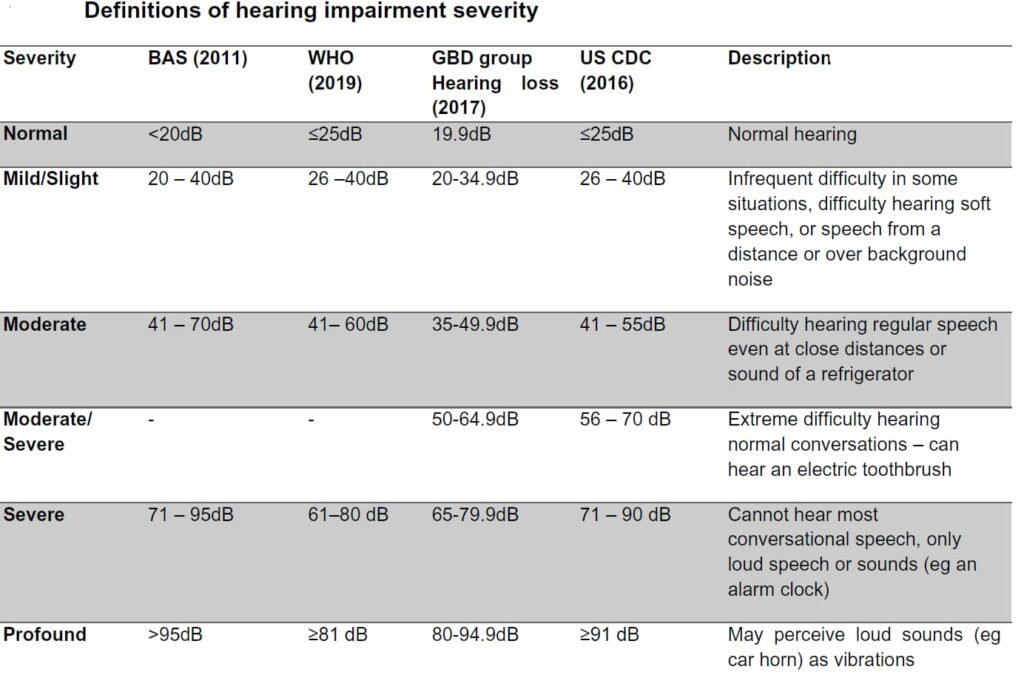
Children (under 15 years old): the average non-aided hearing threshold of the better ear at 500, 1k, 2k, and 4kHz is ≥31 dBHL. This definition also clearly expresses the concept that the diagnosis, treatment, and intervention of hearing loss in children should be prioritized, followed by adults. The classification of the degree of hearing loss is calculated based on the average hearing threshold of the better ear at 500, 1k, 2k, and 4kHz: Mild 26~40 dBHL, can hear and repeat normal speech at 1 meter, some people may need hearing aids, but most people do not; Moderate 41~60 dBHL, cannot hear conversation clearly, hearing aids are usually recommended; Severe 61~80 dBHL, can hear some words when shouting, and hearing aids are of great help to hearing; Profound ≥81 dBHL, it is extremely difficult to hear sounds, Deaf ≥95 dBHL, cannot hear or understand speech, hearing aids or cochlear implants are of great help to understanding speech.
(1) Hearing disability grade one: unable to hear almost any sound
The structure and function of the auditory system are severely damaged, with an average hearing loss of more than 90 dBHL in the better ear, unable to hear almost any sound without the help of hearing devices, unable to on hearing for speech communication, extremely limited in understanding and communication activities, and seriously impaired in participating in social activities.
(2) Hearing disability grade two: can only the sound of firecrackers, drumming, or thunder
The structure and function of the auditory system are severely damaged, with an average hearing loss of 81 90 dBHL in the better ear, can only hear the sound of firecrackers, drumming, or thunder without the help of hearing devices, severely limited in understanding communication activities, and seriously impaired in participating in social activities.
(3) Hearing disability grade three: can only hear a larger part of the speech sound
The and function of the auditory system are moderately severely damaged, with an average hearing loss of 61 to 80 dBHL in the better ear, can only hear a part of the speech sound without the help of hearing devices, can only hear some words or simple sentences, moderately limited in understanding and communication activities, and moderately impaired in participating in activities.
(4) Hearing disability grade four: can hear speech sound, but cannot distinguish it
The structure and function of the auditory system are moderately damaged with an average hearing loss of 41 to 60 dBHL in the better ear, can hear speech sound without the help of hearing devices, but cannot distinguish it, limited in understanding and communication activities, and slightly impaired in participating in social activities.
What are the examination methods for hearing disabilities?
Requirements for the testing environment Bare-ear hearing tests should be conducted in an audi room, and deafness screening examinations can also be conducted in a quiet room (ambient noise < 50 dBA), with restrictions on non-test personnel entering the. Speech recognition tests are conducted in a regular quiet room, using the pronunciation of the locals, with speech sounds at about 70 dB SPL (normal speaking voice) and the ambient noise in the room is less than 50 dBA.
Methods of Assessment: (1) Behavioural Audiometry: The hearing loss is determined by observing the behavioural response of the subject to sounds of different frequencies and of different stimulus sound levels. (2) Speech Recognition Test: The monosyllabic word recognition is done by lip-reading, the examiner and the subject sitting side by side at a distance of half a meter from the subject’s better ear, and the examiner (who is a local person) pronounces in normal conversational voice, taking care not to be seen by the subject, and the percentage of correct recognition of the monosyllabic words by the subject is determined.
Notes: ① All references to deafness mean that the person is deaf in both ears, and if the hearing is different in both ears, the better ear is taken as the basis. ② If a person is deaf in one ear only and the average hearing loss in the other ear is ≤ 40 dB HL, he is not classified as deaf.
So, what about those who are not deaf but have hearing anomalies?
What is hearing loss?——————————————————————–NO.1
Hearing loss refers to the condition where there is a decrease in hearing ability due to organic or functional abnormalities in the sensory conductive, and central auditory systems of the ear.
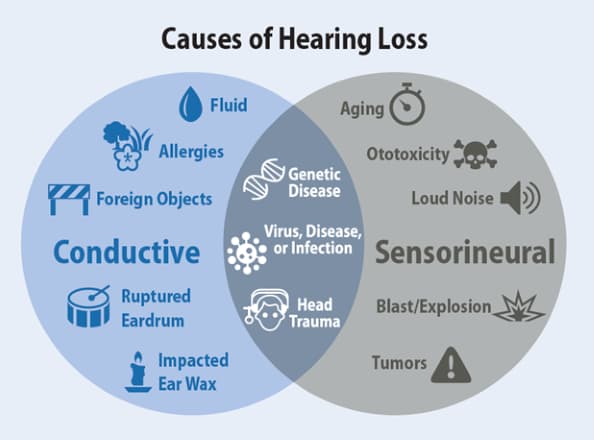
NO.2——————————————————————-Causes of hearing loss
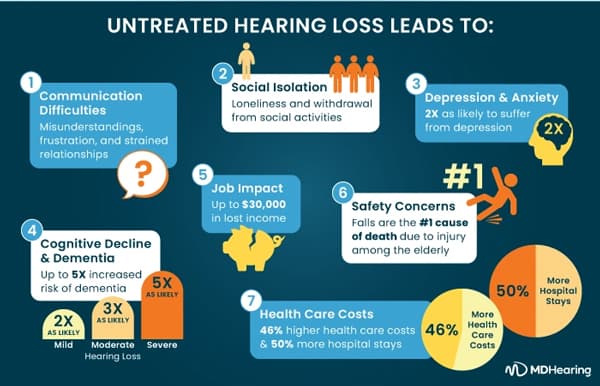
The dangers of hearing loss————————————————————-NO.3
NO.4————————————————————————Causes of hearing
Conductive deafness After the removal of the cause by medication or surgery, the degree of hearing loss can generally be alleviated or even restored.
Sensory neural deafness Those with a moderate or greater degree of hearing loss should be treated with hearing aids as a first choice, and cochlear implantation for hearing reconstruction should be considered when the compensation effect of hearing aids is not good.
Mixed deafness It refers to the coexistence of conductive deafness and sensory neural deafness, and a comprehensive treatment method should be adopted, and symptomatic treatment should be given according to the cause.
How to train after selecting a good hearing aid device?——————————NO.5
Training of listening ability
Perception and listening training of target auditory information in quiet and noisy environments: Through the discrimination training of different phones and words, the listening and understanding ability of speech in daily life is improved
Speech ability training
Non-verbal oral motor training: Through the training of strength and flexibility of speech organs, the foundation for speech formation is laid
Reorganization of oral muscle target speech prompting training, minimal phonetic contrast training: Reorganizing the of speech-related muscles, guiding out the correct position and method of articulation, strengthening speech, and then through the contrast training between minimal phonemes, achieving the acquisition strengthening of speech
Perception and listening training of target auditory information in quiet and noisy environments: Using professional voice analysis intervention instruments, under the visual enhancement, guide normal voice, and correct the wrong voice emission mode
Functional communication group training: Organize relevant group training, simulate relevant communication scenarios in daily life, and conduct dialogue training, so to improve practical communication skills, and make an effective transition to further return to daily life and work.
The hearing aid dome is the “bridge” connecting the hearing aid to the user’s ear canal, and its functions cover three dimensions: acoustic optimization, physical fixation, and health protection. When choosing, it is necessary to consider the type of hearing loss, the anatomy of the ear canal, lifestyle, and the model of the hearing aid comprehensively, and to adjust under the guidance of a professional audiologist to maximize the hearing effect. The role of the hearing aid dome is not only about comfort but also directly affects the transmission effect of sound and the overall performance of the hearing aid. Below is a detailed guide to choosing a hearing aid dome, covering types, applicable scenarios, precautions, and maintenance suggestions to help you make the right choice based on your personal needs: 01 hearing aid dome types and characteristics 1 Standard hearing aid dome (universal type) 2 Custom ear mold 3 Open hearing aid dome (with ventilation hole) 4 Closed hearing aid dome 5 RIC/RITE dedicated hearing aid dome 02 Key Factors to Consider When Choosing Ear Plugs 1 Degree of Hearing Loss 2 Comfort and Fit 3 Management of Plugged Ear Effect 4 Usage Scenarios 5 Special Needs 03 Notes for Trial and Adjustment 1 Professional Fitting: 2 Feedback Squealing Troubleshooting: 3 Comfort Test: 04 Maintenance and Replacement of Ear Plugs 1 Cleaning Methods: 2 Replacement Cycle: 3 Storage Recommendations:
Nowadays, Bluetooth technology has been widely used in various fields, and the hearing aid industry is no exception. For example, the Bluetooth technology we often use been well applied to hearing aid products, bringing more convenience and practicality to the user experience. Many functions that could not be realized in the past have now been realized through technology. The Bluetooth function of the hearing aid is the biggest change in the function of the hearing aid in recent years. The advantages of Bluetooth hearing aids Bluetooth hearing aids integrate Bluetooth functionality, allowing wireless connection to your mobile phone or television. This is a very convenient feature for hearing aids. With Bluetooth hearing aids, mobile phone or television signals are transmitted directly to the hearing aid via radio (Bluetooth), and the effect is very good, with no distortion and no loss of signal. Bluetooth-enabled hearing aids can be wirelessly programmed, connected to mobile phones to make calls and listen to music, connected to wireless microphones to achieve long-distance communication and communication, wirelessly connected to televisions, etc., watching TV will not affect others, making listening clearer. Moreover, Bluetooth hearing aids can also be wirelessly connected to debugging software, making it more convenient to debug hearing aids. Real-time APP connection Bluetooth functionality is not just about connecting hearing aids to your phone, it also works in conjunction with a Bluetooth hearing aid app, which allows you to control your hearing aids from your phone at any time and anywhere. However, some Bluetooth hearing aid models or brands have their own app applications, which can fully leverage the advantages of Bluetooth functionality. Solving the problem of making phone calls The problem of unclear and inconvenient phone calls has been solved. The hearing aid only needs to be paired and connected with the mobile phone’s Bluetooth. When there is an incoming call, the Bluetooth hearing aid becomes a wireless Bluetooth headset, avoiding the feedback phenomenon of the hearing aid. Solving the problem of watching TV The Bluetooth headset can effectively reduce the attenuation of sound. Some deaf users like to watch TV, but ordinary hearing aids are still not very effective. Now that there is a Bluetooth hearing aid, you can pair it with a TV box for watching TV. After matching, the sound in the TV is directly transmitted to the hearing aid, which improves the listening effect and does not affect the family watching TV. Realizing long-distance transmission Bluetooth hearing aids can achieve long-distance transmission, with no attenuation of sound transmission, good transmission stability, clearer and more comfortable sound, less signal interference, and can be connected with wireless accessories for use. It can be connected with a wireless microphone, and the microphone can directly receive the language signal, which can achieve long-distance conversation, such as conversation places such as meetings and classrooms. Connect your phone to listen to music and scroll through videos Bluetooth hearing aids can connect to your phone via wireless Bluetooth function, which can better answer calls, watch videos, listen to music, etc. For deaf people who love music and like to listen to songs and scroll through short videos, this function is extremely friendly to them, and there is no need to worry about it. Reduce interference from the surrounding environment Wireless Bluetooth technology can effectively reduce interference from the surrounding environment. We can connect the hearing aid to Bluetooth and choose to attenuate the microphone function, so we only hear the signal sound from Bluetooth, and block other interference sources. With the increasing demand for telephone communication, video chat, watching TV, browsing short videos and other behaviors deeply into everyone’s life, our demand for hearing AIDS will also change. Therefore, when the existing hearing AIDS can not meet the above behaviors, you can consider using a wireless hearing AIDS, through the wireless connection between hearing AIDS and devices, so that listening effects are better. However, no matter how convenient the wireless Bluetooth function of the hearing aid is, it is not perfect and still has shortcomings, such as high price, fast power consumption, model restrictions, unstable signals and so on. In fact, wireless Bluetooth hearing AIDS are not the needs of all hearing aid users, users can choose according to their own actual situation, believe that in the future, the wireless Bluetooth technology of hearing AIDS will be better and better.
Why do hearing aids vary so much in price? If you’re considering purchasing a hearing aid, you might be surprised to find that the price range in the market can be extremely wide—from cheap devices costing a few tens of dollars to high-end models that can go up to a few thousands. Why is there such a big price gap? Is an expensive hearing aid really better than a cheaper one? This article will provide you with a detailed analysis of the factors behind the price of hearing aids, helping you make a more informed decision when it comes to making a purchase. First and foremost, the price difference of hearing aids is closely related to their types. Currently, hearing aids on the market are mainly divided into the following categories: (1) Over-the-Counter (OTC) Hearing Aids (2) Standard Digital Hearing Aids (3) High-end Custom Hearing Aids (4) Implanted hearing aids (such as cochlear implants) (1) Material The materials used in cheap and expensive hearing aids are different. Hearing aids made from low-cost materials have a shorter lifespan and the sound amplification and reproduction will have a significant distortion, affecting listening quality and satisfaction. Expensive hearing aids use better materials, which last longer and are less likely to break. The sound reproduction is more realistic and clear. (2) Technology Cheap hearing aids are more like a combination of speakers, amplifiers, and microphones. They simply amplify the sound without any processing, including amplifying the surrounding noise along with the sound into the ear canal. Expensive hearing aids have chips and algorithms. They process the collected sound, amplifying the speech sounds more and suppressing the noise. This makes the sound heard by the ear clearer and cleaner. (3) Function Cheap hearing aids can only simply amplify the sound, without noise reduction function, without strong sound interruption function, and are not friendly to the ears. Expensive hearing aids have an automatic noise reduction function, have an instantaneous loud sound interruption function, avoid too loud sound breaking the eardrum, and some expensive hearing aids have a Bluetooth direct connection function, which allows us to hear music and watch videos with a cleaner sound. (4) Service (5) Brand and market positioning (6) Appearance and customization (1) Advantages and Disadvantages of Cheap Hearing Aids (<$500) ✅Pros: ❌Cons: (2) Advantages and Disadvantages of Mid-Range to High-End Hearing Aids ($500-$5,000) ✅Pros: ❌Cons: 4.How to Choose the Right Hearing Aid for You? (1) Assess Your Hearing Needs (2) Set a Budget (3) Trial Period and After-Sales Service (4) Consult with a Hearing Expert As technology advances and market competition intensifies, the price of hearing aids may gradually decrease, especially with the growing popularity of OTC hearing aids that make it possible for more people to get help at a lower cost. However, high-end hearing aids will still maintain higher prices due to ongoing technological innovations. Conclusion: The most expensive is not always the best, but the cheapest may not be sufficient. The price difference in hearing aids reflects a combination of technology, service, and brand value. If you have mild hearing loss, OTC hearing aids can be a good choice; but if you need better sound quality and adaptability, investing in a mid to high-end hearing aid might be more worthwhile. Most importantly, make an informed choice based on your hearing needs, budget, and lifestyle, and consult a professional audiologist if necessary. We hope this article helps you understand the price differences in hearing aids and find the best solution for you! If you have any questions, feel free to leave a comment and join the discussion. Your hearing health is worth the investment, choose the right hearing aid and let the world sound clearer! 🎧


听力残疾四级能听到言语声,但辨别不清-1.jpg)